Showing posts with label FARM. Show all posts

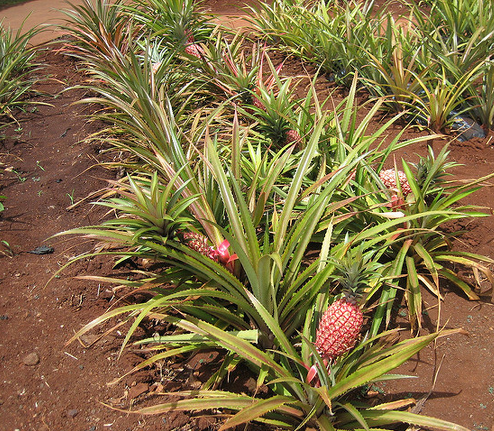
PINEAPPLE CULTIVATION 2


3) Fertilization

In planting pineapple done giving of manure with a dose of 20 tonnes per hectare. How the grant:

• Be mixed evenly with a layer of soil over or inserted per hole for planting
• Use of inorganic fertilizers. Nitrogen (N) is indispensable to the growth of plants, phosphorus is needed for several months in early growth while Potassium is necessary for the development of fruit, especially pineapple. Its use of fertilizer, combined with the flowering stimulus.

Planting Techniques

Determination Of Planting Patterns

The cropping pattern is setting the layout of crops and crop kinds of sequences with given time, within a year. Pineapple cultivation in engineering there are several cropping systems, namely:

• Single line System or square with a distance of planting 150 x 150 cm both within and between rows; 90 x 30 cm distance in rows 30 cm, and the distance between rows is 90 cm
• Double line System with the planting distance is 60 x 60 cm, and the distance between rows of the left and right of the 2 rows are 150 cm and the distance of planting 45 x 30 cm, and the distance between the rows of plants to the left and right of the 2 rows of plants is 90 cm
• Triple row System with a distance of 30 x 30 cm planting forms the equilateral triangle with the distance between the rows of the left or right of the 3 rows of plants: planting and spacing 90 cm 40 x 30 cm with the distance between the rows of the left or right of the three ranks is 90 cm
• System line with distance fourfold 30 x 30 cm and the distance between rows of the left or right of the 4 row crop 90 cm.

The Planting Hole Making

The planting hole making on the trunks is selected in accordance with a system of planting. The planting hole size: 30 x 30 x 30 cm.
Planting

Good planting is done at the beginning of the rainy season. The steps are done:

• Make the planting hole in accordance with the distance and the selected cropping systems
• Take the pineapple seeds healthy and good and planted seedlings in planting holes available, each one seed per planting hole
• Soil pressed or compacted around the base of the stems of pineapple seedlings in order not easily collapsed and plant roots can direct contact with groundwater
• Done watering until the ground is damp and wet
• Planting the seeds of a pineapple don't get too deep, 3-5 cm section of the base of the stem buried in the ground so seeds easy foul.
Plant Maintenance
• Thinning and the stitching is
Spacing is not done because the pineapple, pineapple plant specific and not shaped like a tree. The activities of the stitching is required to replace pineapple plants that don't grow well in hopes of obtaining a uniform crop and synchronously.
• Weeding
Weeding is required to clean out the pineapple garden of weeds and weed competitor in terms of pineapple plant needs water, sunlight and nutrient elements. Weeds often become a den of disease. The weeding time depends on the growth of weeds in the garden, but to save the cost of weeding is done simultaneously with the activity of fertilization. Way of weeding is done by unplugging the grass. The soil around the base of the stem are seedbed on pineapple.
• Fertilizing
Fertilizing plants were carried out after 2-3 months with artificial fertilizers. Fertilizing subsequent repeated every 3-4 months to plant flowering and fruiting. Fertilizer following repeated every 4 months with the same dose.
• Irrigation and Watering
Although the pineapple plant resistant to a dry climate, however for optimum plant growth required enough water. Irrigation/watering done 1-2 times a week depending on the circumstances or the weather. Pineapple plant adults still need watering to stimulate flowering and fertilization optimally. Soil that is too dry can cause growth of dwarf and pineapple fruit is small.

4) Harvest


Harvest pineapple done after the age of 12-24 months, depending on the type of seed to be used. Crown seedlings originating from the flowers bear fruit at the age of 24 months, to harvest the fruit after 24 months. The plant comes from the stem shoots were harvested after age 18 months, while the root buds after 12 months.

Pineapple fruit traits that are ready for harvest:

• Open the fruit Crown
• Stalk change shrinks
• The eyes of fruit are more horizontal, round shape and large
• The color of the bottom of the yellow fruit
• Embossed pineapple fragrance, fragrant and distinctive.
If the fruit is ready for harvest, typically will grow pineapples under the parent tree seedlings are commonly called seeds of the armpit. So the cutting down of trees harvested pineapple with the parent, but still let the pineapples growing saplings beside or below.

How to harvest the pineapple:

• Pineapples are harvested by way of the base of the stalk horizontally or tilted cut fruit with a sharp knife and sterile
• Harvesting is done carefully so as not broken and bruised
• A plant that was 4-5 years need to be rejuvenated because its growth is slow and small fruits

How to disassemble a whole rejuvenation of the pineapple plant is to be replaced with the new seeds.
Potential production per hectare of a pineapple plant cultivated intensively can reach 38-75 tons/hectare. In general the average 20 tons/hectare, depending on the type of pineapple and planting systems.


PINEAPPLE CULTIVATION 1

PINEAPPLE CULTIVATION 1

A. Nursery

Pineapple planting success largely determined by the quality of the seed. Pineapple can captive breeding with the vegetative and generative way.

• How are vegetative shoots shoots from the root, stem, buds of fruit, fruit crowns and stem cuttings.
• Generative Ways with seeds that are grown with the seedbed, (rarely used). A good quality seeds must come from plants that grow in normal, healthy and free from pests and diseases.

a) Seed requirements

The good seeds should have leaves that look thick-thick contains full, free of pests and disease, easily obtained in large quantities, relatively uniform growth and easy transporting mainly to seedling stem cuttings.

b) Preparation of a seed

The seeds of a pineapple from seeds (generative) are rarely used because it requires special techniques and some kind of pineapple can not perform pollination itself and do not produce seeds.

How reproduction in a vegetative (root shoots) has distinctive features:

• Shoots growing from the stem section located in the ground
• The number of shots per clump of relatively few roots
• The shape of the leaves is more slender, adolescence root shoots are relatively short.

Other vegetative way (sprout stems) discrete shoots growing from the stem and the number of shoots per clump are relatively low.

Bud of the stem has distinctive:

• Shoots that grow on stalks of fruit under the fruit stalks and buds at the top of the stem
• Number of buds of fruit per plant are relatively a lot until it reaches 10 buds and shoots size varies from plant growth.

For vegetative way to the Crown of the fruit characteristics are:

• Shoots grown from the eyes of a non-active bud on the stem
• Then sown in sterile media with a special treatment as well as the number of seedlings produced many, uniforms, and easy to transport.

Preparation of seeds (the seeds) to pineapple plant seed buds differentiated into stems and seeds of pineapple from the cuttings. Preparation of seedling stem shoots:

• Select the parent tree trunk shoots which are fruiting/after harvest
• A good stem Shoots is the length of 30-35 cm.
• The leaves near the base of the tree was cut to reduce evaporation and makes it easy to transport
• After that leave for several days in the shade and the seeds are ready to transport to the place of direct planting soon planted.

For the preparation of pineapple seedlings from cuttings, the first step being performed are:

• Cut the stems of pineapple that already harvested the fruit along the 2.5 cm
• Then the pieces split into 4 sections containing the eye shoots
• For Media in the form of clean sand in the planting
• Seedlings produced with a height of 25-35 cm or 3-5 month revoked
• Are planted in the garden. When the seedlings will be transported in the distance, its roots wrapped in moist humus

c) Seeding Technique

The seedbed for pineapple require special treatment:

• It would be better if smeared aphrodisiac root (Rootone) on the surface parts of the rods to accelerate the growth of roots
• Parts of the stem on tub sown deep 1.5-2.5 cm planting distance and 5-10 cm
• Media Condition the seedbed is maintained to keep it moist and good air circulation, by covering with a plastic tub of the seedbed light translucent sheet
• Pineapple Stem Cuttings are allowed to germinate and take root. The media propagate nourished with compost
• Mixed media fine dirt, sand and smooth or granulated manure manure with smooth 

d) Of Nursery

Nursery/nursery maintenance, watering:

• Conducted periodically maintained in order for the condition of the planting medium is always moist and not dry so that the seed does not die
• Fertilizing is done by administering compost by comparing levels already determined
• Grant of a pesticide can be made if necessary
• Transfer of seedlings can be done if the size of the seedlings reaches a height of 25-30 cm or 3-5 months.

B. Planting Media Processing


1) Land preparation

• Preparation time and the opening of the land that is best when its summer time
• Dispose of trees not required
• Tillage can be done at the beginning of the rainy season
• Soil treated with hoe/hijacked as deep as 30-40 cm to lose
• Let the soil become dry for at least 15 days, so that ground ready planted

2) Establishment of the seedbed

The formation of the seedbed can be done simultaneously with the processing of the ground for a second time to suit the cropping systems being used. Seedbed enough by way of:

• Leveling the land
• Created the channel inflow and water disposal
• The system seedbed is done by way of making the dike wall-dike wall as wide as 80-120 cm
• The distance between the dike wall 90-150 cm or other variations of the cropping system in accordance with the
• Height map or dike wall is between 30-40 cm or adjust.


PINEAPPLE CULTIVATION 2

Stages of the cultivation of plants


Currently the demand for herbal drugs are increasingly high. Various types of medicines are already using basic ingredients, medicinal herbs as the main ingredient of drug makers. Often the price offered herbal medicine manufacturer outrageously high.

The cultivation of medicinal plants in the Yard of the House as an alternative replacement, herbal remedies that are on the market. You can also save some money up to 80%, the remaining 20% can be in need to buy pots and fertilizers for growing herb lawns.

Success in planting a crop is indicated by growing and growing plants you sow them. Not a few are indeed failing in terms of cultivation of this plant, but it is not recommended to lose motivation to plant just about any plant you want to embed. You have to keep the spirit of doing your hobby on this one.
Stages of the cultivation of plants are done as follows:

Land management

Some things that should be noted in the land for cultivation medicinal plants include:
  • For medicinal plants that are free of the results in the form of bulbs (tuber) is generally the desired processing-processing of land deep enough (25 – 40 cm), the loose structure so that the growth of the rhizome or tuber can be well developed.
  • Avoid mixed parent material that has not occurred on the grounds of weathering plant. For it needs for sufficient time to give the chance of occurrence of weathering processes, among others, the process of oxidation, so it will form layers of soil that ensures the growth of roots. It was important at the time of making the hole the ground (as deep as 40 x 60) for medicinal plants, trees, shaped like cloves (Eugenia caryophyllata), Kola (Cola nitida).
  • Manufacture of terrace – terrace when the ground is too tilted, so that erosion can be minimized, e.g. in planting Citronella (Cymbopogon nardus).
  • Intensive tillage, weed free and tried in the early growth of medicinal plants.
  • The making of land for planting seeds, often equipped with drainage channels, especially for plants that are not tolerant of standing water. Like Chili (Capsicum annuum).

Planting

Things that need to get consideration on the cultivation of medicinal plants, among others:
  • Given to General cultivation on dry land without irrigation and the weather is hot enough, then the planting was done at the beginning of the rainy season.
  • Planting with distance or regular line will be better viewed in terms of the physiology of plant maintenance and aesthetics.
  • Planting singly (monoculture) especially for plants that cannot bear the light of the Sun, e.g. Menthol (Mentha piperita).
  • Double Planting can be done on plants that require shade or for its growth can adapt to indirect sunlight, for example, Cubeb (Piper cubeba). Plants that can be mutually tolerant of competition because they can meet several objectives, among others: expand the acreage for planting (at one place and time were planted more than one kind of plant), saving maintenance, decrease the risk of crop failures. The use of cantilever for medicinal plants that have stems of climbing plants with a system of dual stanchion can only be replaced by an upright and then plants can also produce.
  • Population of plant closely related to results, among others, influenced by the occurrence of competition between plants and soil fertility.

Plant maintenance

Some measures on maintenance of medicinal plants are:
  • Seeds are easily withering, the need for the timing of his planting so it does not get excessive sunlight, such as planting Tempuyung (Sonchus arvensis) should be done in the afternoon and was given the temporary shade.
  • Weeding intensive in order to suppress the weed population besides can reduce the chance of growing the crop effort can also interfere with the results of hygiene at the time of harvest (i.e. On the plant, Mentha arvensis)
  • Hoarding and make the land becomes tender is done in order to improve the nature of the ground where it grows.
  • To reduce evaporation (evaporation) of groundwater, so soil moisture can keep fit, do the giving of mulch. For example, in plant ginger (Zingiber officinale) the granting of straw mulch can increase the yield of 35%.
  • Pruning flowers, which means preventing changes to the generative vegetative phase many requires energy, so the nutritious substances as a source of energy is not reduced. On the plant glycosides diosgenin content of Dioscorea compositae can grow with done trimming interest rates.
  • Trimming the tops of the stems will stimulate branching, so as to increase the number of leaves that grow as well as the content of the principal in the roots grow. For example, Orthosiphon stamineus.

Harvest

Some of the determination when the harvest:
  • For the plant Familia Zingiberaceae, harvesting is done at the time of the above ground parts of the plants ripen or yellow that normally occur in the dry season, and if that's taken root. For Example (Curcumaxanthorrhiza)
  • Leaves collected during the process of photosynthesis a maximum before the formation of the fruit. E.g. plant Saga (Abrus praecatorius).
  • Flowers are picked while still in bud (before) for example, at clove (Eugenia caryophyllata).
  • Fruit picked ahead of Cook, e.g. Solanum laciniatum while fennel Anethum graveolens is quoted after Cook was right.
  • Seed should have at the time of fruit ripening.
  • Skin has taken during sprouting.